
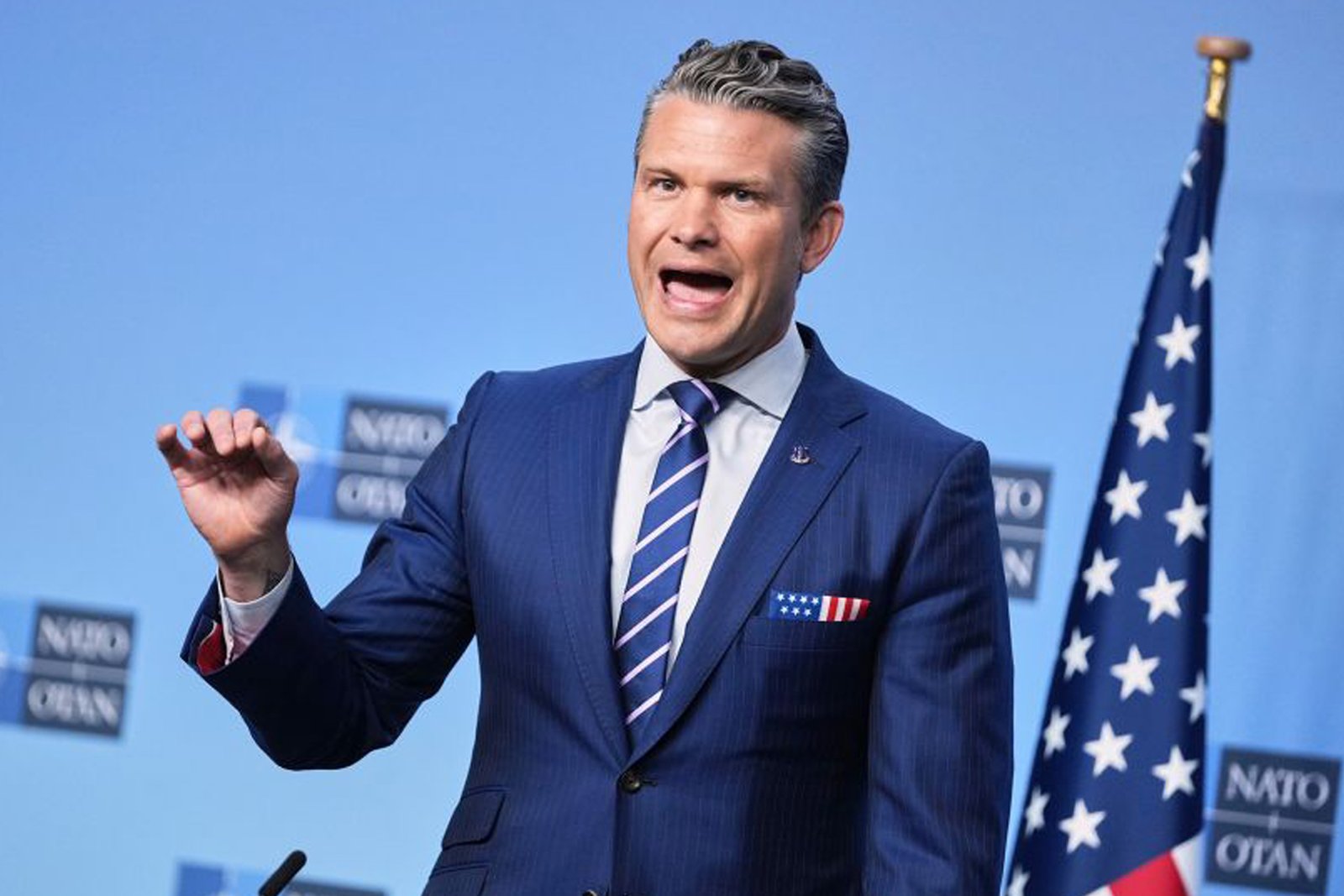
US Defense Secretary Pete Hegseth said on Friday that the US military campaign against Iran has been very successful. Speaking at a press conference at the United States Department of Defense, he accused journalists of not reporting enough about what he called major US victories. Hegseth said the media was focusing too much on problems instead of the results of the military operation.
Hegseth spoke alongside Dan Caine, the chairman of the Joint Chiefs of Staff. He claimed that after 13 days of US and Israeli strikes, Iran’s military had suffered heavy damage. According to him, Iran no longer has a fully functioning air force, navy, or missile defense system.
He also said the combined air campaign by the US and Israel had attacked more than 15,000 targets since the war began. Hegseth told reporters that the US military was weakening the Iranian government’s forces in a way “the world has never seen before.”
The defense secretary said Iran’s ability to produce ballistic missiles had been severely damaged. He also claimed that Iranian leaders were hiding underground because they were afraid of the attacks. However, videos released the same day showed several top Iranian officials taking part in a public rally in the capital.
Among those seen in the videos were Iran’s president Masoud Pezeshkian, senior political figure Ali Larijani, and foreign minister Abbas Araghchi. They were marching in Tehran during the annual Quds Day rally, an event that shows support for Palestinians.
Hegseth also said that Iran’s new supreme leader, Mojtaba Khamenei, had been injured in an earlier Israeli strike and might have been badly wounded. Mojtaba Khamenei became leader after the assassination of his father, Ali Khamenei, earlier in the conflict. However, this claim about his injuries has not been independently confirmed.
Military analysts say the attacks have indeed caused serious damage to Iran’s military facilities. The Institute for the Study of War said satellite images show destruction at missile bases, air bases, and naval facilities across Iran. Even so, Iran has continued to carry out attacks in response.
Iranian state media said the Islamic Revolutionary Guard Corps has launched missiles and drones at US military bases in Gulf countries and at Israel. These attacks show that Iran still has the ability to strike back despite the damage to its military infrastructure.
During the press conference, Hegseth also confirmed that the US military is investigating a controversial airstrike that hit a girls’ school in Iran. The strike reportedly killed at least 175 people. He said the investigation is being led by a general from outside the regional command.
Hegseth did not give details about the incident but said the investigation was ongoing. Some early reports suggest that the US strike may have been responsible for hitting the school building. The final results of the investigation have not yet been released.
At the briefing, Gen. Dan Caine also revealed that the US had used a new type of precision missile during the conflict. According to him, it was the first time this advanced weapon had been used in real combat. These missiles are designed to travel farther and hit targets more accurately than older weapons.
Despite the claims of strong battlefield success, the Pentagon admitted that the Strait of Hormuz remains partly closed to commercial shipping. The strait is a crucial route for oil shipments from the Persian Gulf, including exports from Iran itself.
Hegseth dismissed reports that the US had been unprepared for Iran’s actions in the strait. He said ships could pass through if Iran stopped attacking vessels in the area. According to him, the only reason shipping has slowed is because Iran has been firing at ships. Throughout the press conference, Hegseth repeatedly criticized the way the war has been covered by news organizations. At one point, he even suggested what television headlines should say about the situation.
He joked that news banners should read “Iran increasingly desperate” instead of focusing on the challenges facing US forces. His comments reflected ongoing tension between the Pentagon and some media outlets covering the conflict.
One journalist later said that some reporters were not allowed into the press briefing. Print photographers were also reportedly blocked from attending. According to reports, officials were concerned that some photos of Hegseth published earlier had been “unflattering.”
Hegseth also criticized the network CNN during the briefing. He mentioned media executive David Ellison, who is reportedly trying to buy the company that owns CNN, Warner Bros. Discovery. Hegseth said the network might improve if Ellison takes control.
At the end of his remarks, Hegseth repeated a message he often shares during press briefings. He asked Americans to pray for US troops serving overseas. He also said his duty was to serve God, the military, the country, the Constitution, and the president of the United States.